Recycling and Sustainability at Gardeners Hayes
Welcome to Gardeners Hayes — where our commitment to an eco-friendly waste disposal area and a resilient sustainable rubbish gardening area shapes every project. Our on-site systems prioritise reuse, resource recovery and low-carbon operations so that garden maintenance, soil improvement and green waste processing reduce environmental impact while supporting local communities.Our Recycling Percentage Target
We have set a clear, measurable ambition: reach a 65% recycling and composting rate across all our garden operations by 2028, rising to 75% by 2035. This target covers diverted materials from landfill, increased on-site composting, and more efficient separation of organic, recyclable and reusable items in the sustainable waste gardening area. Local boroughs increasingly follow a separation-first approach: kerbside collection of food and garden waste, separate dry recycling streams and targeted bulky waste pick-ups. Gardeners Hayes works alongside these local practices so our sorting, storage and transfer routines align with borough-level waste separation standards, improving recovery rates and cutting contamination.
Local transfer stations and facilities
We route materials through trusted municipal and private transfer stations to ensure proper processing. Typical hubs we work with include:
- Riverbank Transfer Station for mixed garden and green waste
- Westborough Materials Recovery Facility for dry recyclables (glass, cans, paper, and plastics)
- Northfield Composting Depot for high-temperature organic composting and soil amendment production
Charity Partnerships and Community Reuse
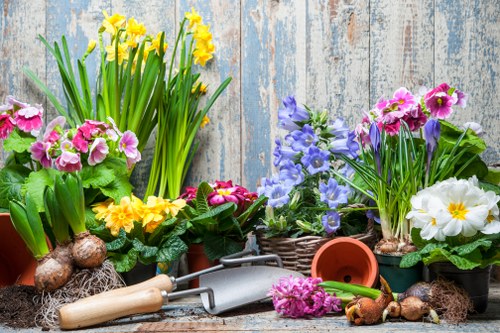
Gardeners Hayes maintains active partnerships with charities and social enterprises to extend the lifecycle of plants, tools and materials. Organisations such as local community garden trusts, plant rescue groups and reuse charities receive surplus plants, pots and gently used tools. This reduces waste, provides affordable resources to community growers, and supports urban greening projects. We prioritise donation routes for salvageable items before considering material recovery.Our operational fleet is part of the sustainability story. We employ a mix of electric vans, plug-in hybrids and ultra-low-emission vehicles for local deliveries and green waste collection. Route optimisation software and scheduled micro-depots cut mileage and idling time, lowering CO2 emissions across our waste collection and transportation network.
 Inside the sustainable rubbish gardening area at Gardeners Hayes we use layered processing: dedicated bays for inert materials, a composting loop for green waste, and covered sorting zones for recyclables. On-site mulching and hot composting accelerate organic recycling, producing a soil-rich amendment that feeds our planting projects and reduces the need for imported peat-based products.
 We publish transparent performance metrics each quarter to show progress toward our recycling percentage target. Regular audits, contamination checks and collaborations with borough waste teams ensure materials are routed correctly. When contamination is detected we apply corrective measures: additional sorting, public-facing information campaigns and adjustments to collection packaging where necessary.
The design of our eco-friendly waste disposal area emphasises segregation at source. Crews are trained to separate materials into clearly labelled streams: garden organics, food scraps, wood and timber, metals, glass and plastics. Separation reduces cross-contamination and improves the yield of recyclable materials that can be sent to MRFs or composting facilities.
We also prioritise circular approaches to soil and plant materials. Compost produced from garden and food waste is tested and returned to planting beds, while chipped woody material becomes mulch that conserves moisture and suppresses weeds in beds. These practices are central to our sustainable waste gardening area model: they close nutrient loops and lower our ecological footprint.
Gardeners Hayes measures success not just in tonnage diverted but in carbon savings and community benefit. By tracking vehicle emissions, transport miles to transfer stations and the quality of compost outputs, we refine practices that deliver measurable reductions in greenhouse gas emissions. Our ambition is to be a local leader in sustainable garden waste management and a replicable model for other green service providers.
To support continued improvement we invest in staff training, equipment for better segregation and partnerships that increase reuse pathways. Collaborative programmes with borough waste teams, reuse charities and centralised composting facilities strengthen the local circular economy and help meet wider municipal recycling goals.
Looking forward, Gardeners Hayes will expand low-emission logistics, increase on-site processing capacity, and build further links with charities that find new homes for plants and materials. Our approach to an eco-friendly waste disposal area and a sustainable rubbish gardening area is practical, target-driven and community-aware — designed to turn garden waste into a resource, not rubbish.
Join us in advancing sustainable garden practice: by prioritising separation, supporting reuse, and backing low-carbon operations we can make landscapes greener and waste streams cleaner across the boroughs we serve.

